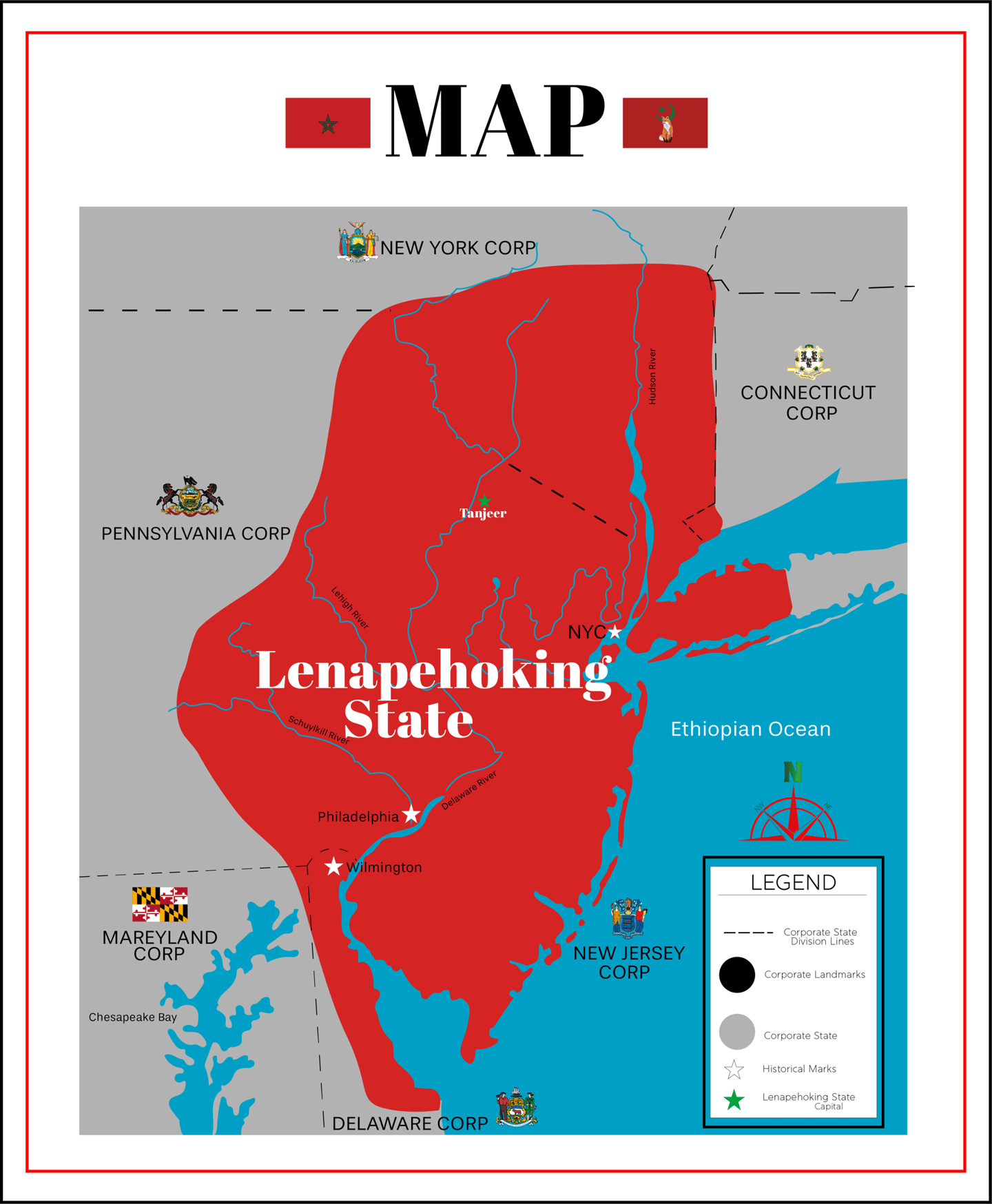
Lenapehoking is a term for the lands historically inhabited by the Al Moroccan people known as the Lenape (renamed the Delaware people by early European settlers) in what is now being referred to as the Mid-Atlantic United States.
Lenapehoking, translating to “in the land of the Lenape.” This term has gained widespread acceptance and is found widely in recent literature on the Lenape.
In the 16th and 17th centuries, the Lenape homeland ranged along the Atlantic’s coast from western Connecticut to Delaware, which generally encompassed the territory adjacent to the Delaware and lower Hudson river valleys, as well the hill-and-ridge dominated territory between them. Relatives of the Algonquian Al Moroccans [Amerindians] whose territories ranged along the entire coast from beyond the Saint Lawrence River in today’s Canada, and the tribes throughout all of New England, down into northern South Carolina, the Delaware Confederation stretched from the southern shores of modern-day Delaware along the Atlantic seaboard into western Long Island and Connecticut, then extended westwards across the Hudson water gap into the eastern Catskills part of the Appalachians range around the headwaters of the Delaware River and along both banks of its basin down to the mouth of the Lehigh.
Inland, the tribe had to deal with the fierce and territorial Susquehannocks; the Delawares’ territory has generally been plotted with boundaries along mountain ridges topped by the drainage divides between the right bank tributaries of the Delaware River on the east—and on the west and south—the left bank tributaries of the Susquehanna and Lehigh Rivers; bounds which included the Catskills, northern parts of eastern Pennsylvania down through the entire Poconos along the left bank Lehigh River. The Schuylkill River and its mouth (future Philadelphia area counties) or right bank Lehigh was contested hunting grounds, generally shared with the Susquehannock and the occasional visit by a related Potomac tribe when there wasn’t active tribal warfare. The greater Philadelphia area was known to host European to Moroccans [referred today as Indians] scontacts from the Dutch traders contacts with the Susquehanna (1600), English traders (1602), and both tribes with New Netherlands traders after 1610
Along the left bank Delaware valley, the territory extended to all of present-day New Jersey, and the southern counties of New York State, including Rockland, Orange, Westchester, and Putnam Counties, Nassau County, and the five boroughs of New York City.
Acknowledgments
With gratitude, NJSACC acknowledges the Lenapehoking (Lenni-Lenape) and the sacrifices of the Lenape people, culture and ancestral homeland in New Jersey, for which we all have been able to thrive. NJ has been the ancestral homeland to the Lenape for over 14,000 years and were forcibly removed and displaced by European colonizers, resulting in a historic diaspora. Some tribal and First nations, officially recognized by the state and federally, maintain communities that still thrive today, located throughout North America, NJ and the greater mid-Atlantic region.
NJSACC | New Jersey's Afterschool & OST Professional Network
University of Delaware
The University of Delaware occupies lands vital to the web of life for Lenape and Nanticoke, who share their ancestry, history, and future in this region. UD has financially benefited from this regional occupation as well as from Indigenous territories that were expropriated through the United States land grant system. European colonizers and later the United States forced Nanticoke and Lenape westward and northward, where they formed nations in present-day Oklahoma, Wisconsin, and Ontario, Canada. Others never leO their homelands or returned from exile when they could. We express our appreciation for ongoing Indigenous stewardship of the ecologies and traditions of this region. While the harms to Indigenous people and their homelands are beyond repair, we commit to building right relationships going forward by collaborating with tribal leadership on actionable institutional steps.
We begin by acknowledging that we are gathered, speaking, and learning on Lenapehoking, the ancestral lands of the Lenape peoples, which settlers call New York City. We do this with humility and gratitude, while recognizing the violence of forced relocation and displacement of the Lenape Peoples with whom this department and university are in an ongoing process of learning. These peoples are known today as the Delaware Nation, in Anadarko Oklahoma; the Delaware Tribe of Indians, in Bartlesville Oklahoma; the Stockbridge-Munsee Community, in Bowler Wisconsin; and the Munsee Delaware Nation, and the Eelūnaapèewii Lahkèewiit, or Delaware Nation at Moraviantown, both in Ontario, Canada.
We acknowledge the need for the recognition of the history of Lenapehoking – a land stolen from, never traded by, the Lenape peoples, who continue to live in New York City and beyond. We acknowledge the systemic and ongoing violence of settler colonialism, and the genocidal violence that resulted in both forced relocation and in physical and psychological trauma perpetrated across generations. We acknowledge in particular that settlers have broken, and continue to break, their treaties with Lenape peoples, beginning with the actions of Henry Hudson and Peter Minuit in first appropriating this land.
We recognize that reparative action requires long-term maintenance and multigenerational efforts to build relationships with the sovereign nations of the Lenape peoples. We commit to upholding an ongoing and living set of commitments with these nations by working directly with Tribal Governments and Authorized Tribal Representatives to ensure our words and actions are in step with our goals.
NYU | STEINHARDT
What is a Land Acknowledgement:
A Land Acknowledgement is a formal statement that recognizes and respects Native peoples as traditional stewards of lands. The statement highlights the enduring relationship between Native peoples and their traditional territories.
Why do we Recognize the Land:
All land in the State of Connecticut was once Native territory, which is why it is our duty to acknowledge that the University of Connecticut a land grant institution, is existing on Native land. It is important to understand the long-standing history that has brought you to reside on the land and to seek to understand your place within that history. Land acknowledgments do not exist in the past tense or historical context: colonialism is a current ongoing process, and we need to build our mindfulness of our present participation. It is also worth noting that acknowledging the land is Indigenous protocol. -http://www.lspirg.org/knowtheland
The Office for Diversity and Inclusion worked with the three co-founders of the Akomawt Educational Initiative to create a land acknowledgment that rightfully recognizes the history of the Native peoples territories. It is important to our office to work with members of the greater Connecticut community to continue our efforts of educating our campus on the value of diversity and inclusion. This initiative continues to fulfill the mission of the Office for Diversity and Inclusion to continue to build a more welcoming and inclusive community.